
Line of Children on the Palm Hand Meaning in Palmistry - AI Hiroman

The Children Line on the Hand in Palmistry

Автор

Татьяна Солнцева

Дата публикации

13.01.2026

Время прочтения

7 минут

Количество просмотров

201 просмотров

The palm holds signs of the future, and particular interest is drawn to the children line on the hand. For many, this thin mark is a chance to learn about offspring: how many children there may be in the family and what they may be like. Palmistry teaches not only to look, but also to thoughtfully analyze the details of the palm. Such knowledge makes it possible to learn more about oneself, loved ones, and destiny.

What the Children Line Is and Where It Is Located

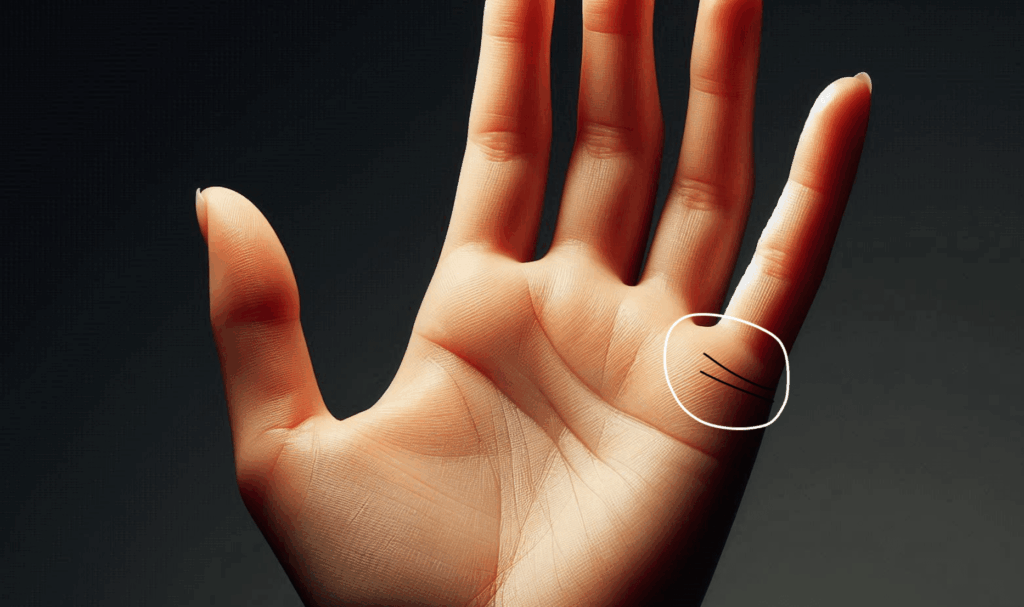
The children line is a short vertical mark at the base of the edge of the palm, closer to the little finger, slightly above the marriage line. The pattern may be a single mark or consist of several parallel strokes; in women it is seen more often, in men it is barely visible or appears only after the birth of a child. The sign is not always distinct: it can be thin, blurred, and become more visible under light.

It is better to identify the line on the active hand — the right for right-handed people, the left for left-handed people. The second palm shows additional possibilities that have not been realized in practice. Photos of women’s hands with explanations help beginners learn: they clearly show how the lines are positioned and how they differ in thickness, length, and clarity.

Sometimes the line changes after life events: motherhood or changes in the family. It is important not to rush conclusions — rely on the combination of patterns and compare with analogues. Want a detailed analysis? Today it can be obtained online through an AI palmist in Telegram.

The Children Line on the Hand in Palmistry

How to Determine the Number of Children by the Line on the Hand

The number of possible children is decoded by vertical marks above the marriage line — clear, short strokes at the base of the little finger. Each distinct segment signals the probability of the birth of a child. Only clearly expressed lines are counted; blurring and shadows are not taken into account. A long vertical line indicates greater significance of the child in life, while faint lines point to the possibility of unborn or adopted children.

For women, these signs are especially informative: two or three clear strokes are often found, indicating a larger or average number of offspring. Branching of the line hints at twins or special destinies among siblings. By learning to compare both palms, it is easy to understand: the working hand reflects what is realized, the second shows alternative possibilities.

It is more difficult for men to see children lines on their hands: their pattern is less pronounced and appears later. Analysis requires a comprehensive approach, including examination of the Mount of Venus and the marriage line. Photos of women’s hands show that if three parallel strokes are present nearby, this most often indicates three children. For confidence, use the AI palmist service: upload a photo for interpretation through a neural network.

Not confident in your conclusions? Try the AI palmist — receive a fast and detailed analysis based on your photo.

How to Determine the Gender of Children by the Lines on the Hand

In palmistry, the gender of children is sometimes interpreted by the thickness, length, and angle of the line. A thin and light vertical line is more often read as a sign of a future daughter; a more noticeable, short, and rough one — as a hint of a son. When the lines on the hand differ in length and depth, such variation indicates children of different genders. Sometimes the strokes are very close together; they are analyzed by comparing them with other signs.

Expert analysis necessarily takes both hands into account and is supplemented by information from the heart line and the Mount of Venus. If two lines of different depth are drawn, this may point to different characters or even different genders of children. When a line branches or curves, some interpret this as a probability of a daughter, while a short line is seen as a son.

Everything is much more conditional than it may seem: no method guarantees a one-hundred-percent result. For confidence, it is useful to compare your palm with photo examples from palmistry blogs or communities. This approach broadens perspective and helps avoid hasty conclusions.

Health and Status of Children: What the Lines Show

An even, clear children line on the palm is considered a signal of strength and good development of the child. Broken, dotted, or island-like details on the mark are associated with difficulties, possible illnesses, or significant events in the child’s life. If the line duplicates or branches, this hints at duality of fate, the appearance of twins, or a difficult period.

Life status can be interpreted by correlating the children line with the condition of the heart line or the expression of the Mount of Venus. Well-defined lines in these areas soften alarming forecasts, indicating family support and a positive emotional environment. In photos, the difference is easy to see: some have an ideal line, others show breaks, spots, or intersections.

The lines can change: they may appear after birth or disappear with changes in the family. For beginners analyzing their palm, it is especially useful to pay attention to the dynamics of symbols and track changes over time.

The Children Line on the Hand in Palmistry

Features of the Children Line in Men and Women

A woman’s palm shows the children line more often and more clearly: this is facilitated by hormonal processes and a strong emotional connection with family. Photographs of women’s hands often illustrate that the line can change after childbirth, motherhood, or stress. By the saturation, length, and depth of the line, one also judges the nature of future relationships between children and mother.

On a man’s hand, the vertical mark usually appears later, is more weakly expressed, and may not be visible at all. Reasons include less pronounced emotions, lack of conscious desire for parenthood, or later life changes. If the line is weakly expressed, other zones should be evaluated: the Mount of Venus, palm shape, and structural features of the marriage and heart lines. Both palms are examined together for an objective picture.

Each personal pattern is unique: the absence of a line does not prevent dreaming of or becoming a parent. It is important to analyze the combination of subtle signs rather than searching for a single stroke.

Signs on the Children Line and Their Meaning

Evaluation of the children line is strengthened by details: branched, island-like, intersecting, or dotted elements. Branching suggests twins or a very close bond between children. An island is read as a possible difficult period, illness, or trial that the child will go through. Intersections and dots mark changes or external influence — stressful events, relocations, or loss of support.

Interpretation is simplified by analyzing the position of the signs relative to the marriage and heart lines, as well as the Mount of Venus. Harmony smooths negative details; breaks intensify concern. In real photos, the diversity of these strokes is clearly visible. It is important to consider all palm details rather than focusing on a single sign.

Understanding of symbols is formed through practice and comparison; competent interpretation is possible after consultation with experts or through specialized online services.

FAQ

Does the children line accurately determine the number of offspring?

Тhe line shows predisposition — coincidences are possible, but no guarantees exist. Life circumstances, health, and personality all play a role.

Why are the marks more pronounced in women?

Hormonal background, emotional attachment, and the maternal role are reflected on the palm, making the line clearer.

Is the line always present in men?

In men, the line is often weak and appears after deciding to become a father or after the birth of a child. It may remain invisible.

Which symbols should be analyzed additionally?

Branching, islands, dots, and other marks are significant. The pattern is always evaluated as a whole, not in isolation.

Does the line change after events?

The mark may deepen, appear, or disappear after life changes and the birth of children.
[bws-rating]